
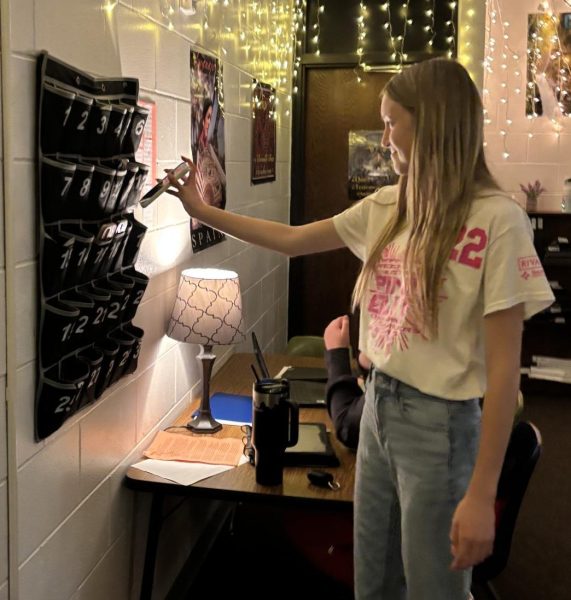
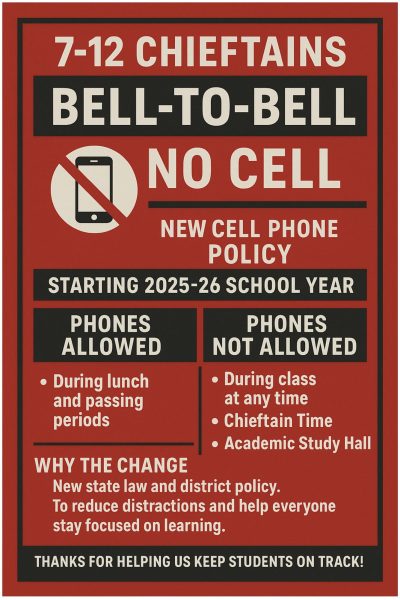
LB140, signed into law on May 12, 2025, mandates all Nebraska school districts to create policies to manage student cell phone use during the school day. Yutan’s new phone policy is similar to what it has been in the past: cell phones should not be used during class time for any reason.
Since most teachers are using existing phone pouches, where students must place their phones at the beginning of class, to enforce this rule, the students aren’t noticing much of a change.
“It’s the same thing, but the teachers and staff are being a little more strict on it, but nothing has really changed for me as a student,” sophomore Kale Hoffer said.
One area of Yutan’s phone policy that did change is the consequences. The first time a student is caught with their phone, it will be confiscated by the teacher until the end of the school day. For a second offence, the student’s phone is taken to the office, where parents will be notified, and the student can pick it up there at the end of the school day. For a third offence, a parent would need to come pick up the phone from the school.
“If the phone continues to be an issue for the student, they may need to check it into the office upon arrival at school or may not be allowed to bring their phone to school at all. We want students to be able to be responsible with their phones and follow expectations,” Yutan High School principal Stefanie Novotny said.
On the State of Nebraska website, Governor Jim Pillen said the reason the law was passed is to decrease addiction, distraction and mental health problems and increase social and emotional development, which are issues that adults in Yutan have been noticing as well.
“I think it’s good to limit phones in the classroom because it is a huge distraction, and students spend so much time on their phones. Adults are guilty of it too; we don’t use our time as wisely as we could and kind of develop some bad habits by spending so much time on our phones,” English teacher and journalism advisor Ginger Eikmeier said.
Besides the addiction, staff have also noticed the lack of social development among students and young adults.
“I have seen student communication skills decline over the years, and it is often a challenge for students to communicate face-to-face with another person, as that skill isn’t practiced as often as it used to,” Novotny said.
Some students agree that addiction, distraction and emotional development are important, and not having phones reduces problems.
“They (phones) can turn into problems if students abuse their right to have their phone, but if they’re not using it, it doesn’t really have an effect on anybody,” Hoffer said.
Others feel like they should have the freedom to be on their phones during school hours.
“I think that having phones in class can have upsides and downsides,” sophomore Morgan Long said. “I think we shouldn’t be restricted to using our phones, especially when we make videos for projects. It’s easier to edit on a phone than it is to edit on a tablet.”
The new policy has caused some challenges for classes that used phones in the past for educational purposes, as Yutan’s policy no longer allows that exception.
“The phone policy has added some additional challenges for journalism. We’ve used phones for educational purposes for the past several years because the program we use for our interviews works significantly better on phones than on Chromebooks,” Eikmeier said. “We also have used phones for recording broadcasts, for making follow-up calls for ad sales and for being able to get pictures in a moment where we might not be able to grab a journalism camera…So there have definitely been some hiccups, but we’re doing our best to manage them.”
Although some classes face challenges due to not being able to use their phones, the results have shown that the policy is effective. As of the end of September, only 11 students have had a first-time offence, and one student has had a second-time offence.
“I think it’s working well. Is it working the best? No, but I have had fewer problems with kids having their phones than before,” English teacher Alyssa Hansen said.
If student phone usage in school becomes a problem, the school will consider banning phones during lunch or other parts of the school day like passing periods.
“We will monitor our current practices and determine if they are working for us or if we need to adjust. With students not having their cell phones at lunch, they would have more opportunities to socialize, talk and get to know peers,” Novotny said.
For now, however, the existing phone policy will be maintained, as it meets all current needs.
“I hope that we follow the policy with some opportunities for students; otherwise, we will have to move to a full ban during the school day,” Novotny said.